 how-to
Does a Sunroom Add Home Value? 2026 Guide
Table of Contents
- Does a Sunroom Add Home Value? The Short Answer
- Sunroom Return on Investment: How to Estimate Yours
- Sunroom Pros and Cons for Home Value
- What a 12x12 Sunroom Cost Really Buys You
- Sunroom vs. Other Renovations: Where the Money Comes Back
- Climate, Orientation, and Year-Round Usability
- Conclusion: Making the Decision With Clear Numbers
- Frequently Asked Questions
Last Updated: October 6, 2026
Does a Sunroom Add Home Value? The Short Answer
Yes, a sunroom can add home value, but the amount depends on how the room is built, how it is classified, and what buyers in your area are willing to pay for. According to the Appraisal Institute's guidance on home additions, an addition only adds value when it is permanent, permitted, and counted in the home's gross living area.
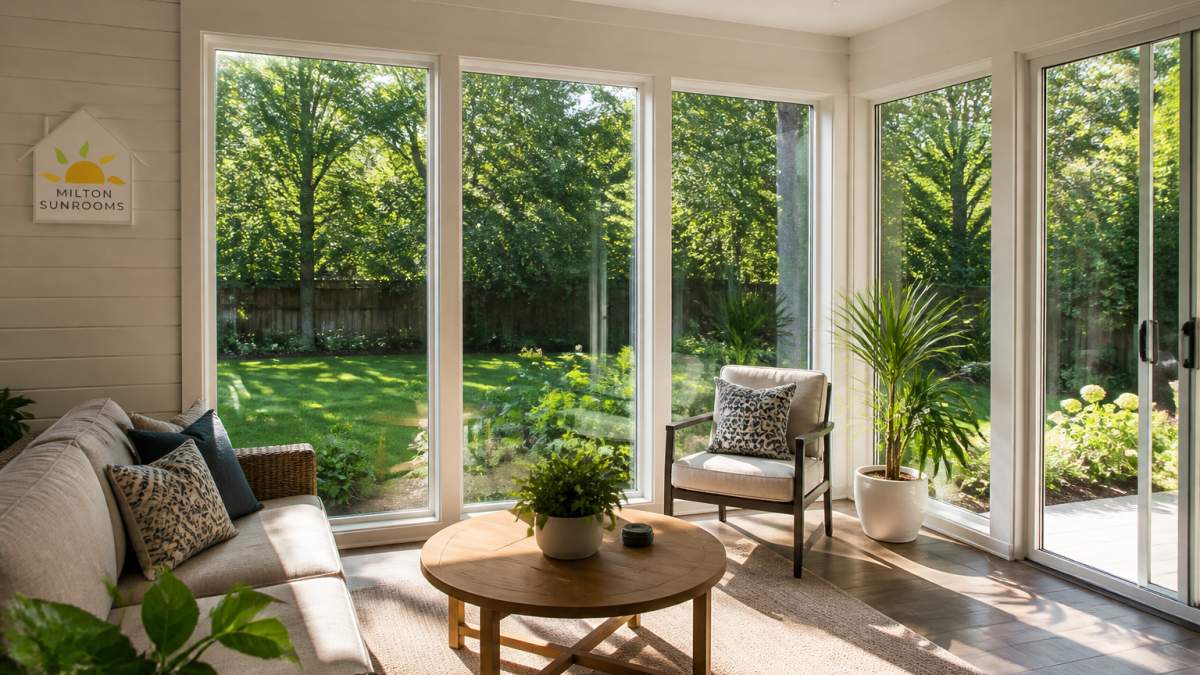
At Milton Sunrooms, we have built custom sunrooms, porches, and patio enclosures across Metro Atlanta and the surrounding counties: Fulton, Bartow, Cobb, Gwinnett, Forsyth, Cherokee, and DeKalb since 2008.
Here is the honest version most guides skip. A sunroom is not a magic value multiplier.
(https://www.miltonsunrooms.com/three-season-porches).
This question decides your return: the difference between "finished square footage" and "a nice porch" can be tens of thousands of dollars at resale.
The Appraisal Checklist: Square Footage, Permits, and Condition
Appraisers do not guess. They verify. Here is the checklist they work through, and the one you should run before you build:
- Is the room heated and cooled year-round?
- Is it built on a permanent foundation or a proper slab?
- Does it have a permit and a final inspection on record?
If you can check every box, the room likely counts. If you cannot, expect it to be listed as a porch or three-season room.
Sunroom Return on Investment: How to Estimate Yours
There is no single national ROI number for a sunroom; any guide that hands you one is guessing. A four-season room in a strong neighborhood can recoup a meaningful share of its cost, while a seasonal porch in a weak market may recoup very little.
So estimate it yourself using the method below, working in dollars rather than percentages and separating the value the room adds from the cost you will never get back.
A Location-Specific Method Using Local Comparable Sales
Here is how to work it out for a home in Milton or Johns Creek:
- Find three recent sales nearby with a sunroom or finished addition.
- Note the price per square foot those homes sold for.
- Compare them to similar homes without the addition.
- Subtract the difference to get the value the room added.
- Divide that value by your total project cost.
That final number is your real ROI. It will be different from your neighbor's, and that is normal.
Step | What You Do | Why It Matters |
|---|---|---|
1 | Pull 3 recent comparable sales | Shows what buyers actually paid |
2 | Note price per square foot | Sets a local benchmark |
3 | Compare to homes without additions | Isolates the room's value |
4 | Subtract to find added value | Gives you a dollar figure |
5 | Divide by project cost | Reveals your true ROI |
A Worked Example With Transparent Assumptions
Numbers make this concrete. The figures below are illustrative; your market will differ, but the math is the same.
Assume a 200-square-foot four-season sunroom in a suburban market where comparable homes sell for about $200 per square foot.
That unrecovered portion is not a loss the way a bad investment is; you got years of use out of the room.
Adjusting for Climate and Buyer Demand
Two homes with identical sunrooms can see very different returns based on location.
- Climate. In a hot, humid climate, an unconditioned room can be unusable for months, so buyers discount it. In a mild climate, a three-season room may be nearly as usable as a four-season one, narrowing the value gap.
- Buyer demand. In a market where outdoor living is a selling point, a well-built sunroom commands a premium. In a market where buyers prioritize bedroom count or garage space, the same room may add little.
- Neighborhood price ceiling. If your home is already the most expensive on the street, an addition may not raise your sale price much, because buyers shopping your block are not paying for the top of the range.
Run the comparable-sales method with these four factors in mind and you will get a number you can plan around, not a national average that describes no one's house.
Sunroom Pros and Cons for Home Value
The pros are real, and so are the cons. Weigh both before committing.
Pros:
- Adds usable, year-round living space
- Boosts buyer appeal in a competitive market
- Repurposes an existing deck or porch
- Improves natural light and views
Cons:
- Costs more than many homeowners expect
- Adds ongoing heating, cooling, and maintenance costs
- May not count as living space if unpermitted
- A poorly built room can hurt a sale
What a 12x12 Sunroom Cost Really Buys You
A 12x12 sunroom is one of the most requested sizes, and its cost depends on materials, insulation, window quality, foundation work, and whether you repurpose an existing deck or start fresh. Two rooms with the same footprint can land at very different price points.
Because pricing varies so much by design and site, we do not quote a single number here. Instead, think of the cost in layers and what each layer buys you:
- Foundation or deck reinforcement. A room built on an existing deck may need new footings or a slab. This is often the difference between a modest project and an expensive one.
- Framing and roofing. A site-built roof tied into the house costs more than a self-supporting kit roof but looks and performs better.
- Windows and doors. This is the single biggest swing factor. Builder-grade sliding windows cost a fraction of custom low-E units, and the difference shows up in comfort and resale.
- Insulation and HVAC tie-in. Extending your home's system or adding a mini-split is what turns a three-season room into a four-season one, and into counted living space.
What Actually Drives the Price Up or Down
A few decisions move the number more than any others:
Decision | Lower Cost | Higher Cost |
|---|---|---|
Foundation | Existing deck, reinforced | New slab or crawlspace |
Windows | Standard sliding | Custom low-E, casement |
HVAC | Space heater, window unit | Tied into a home system or mini-split |
Roof | Kit roof | Site-built, tied into house |
Permits | Pulled and inspected | Skipped (and later penalized at appraisal) |
A homeowner who repurposes an existing deck, uses standard windows, and adds a mini-split spends far less than one who builds from scratch with custom glazing and a full HVAC tie-in. Both can be good decisions, but only one likely counts as living space.
Ownership Costs Beyond Construction
Construction is not the only cost. Plan for these too:
- Higher heating and cooling bills, especially in a room with a lot of glass
- Roof and window maintenance
- Occasional resealing or repainting
- Possible property tax reassessment after the addition
According to the Insurance Information Institute's guidance on home additions, homeowners should notify their insurer after a major addition so the new square footage is covered. Skipping this step can leave you underinsured.
Sunroom vs. Other Renovations: Where the Money Comes Back
Different renovations recover different shares of their cost, and a sunroom sits in the middle of the pack.
So the comparison is not just about ROI. It is about what you get to use every day.
Project | Typical Value Focus | Best For |
|---|---|---|
Sunroom addition | Usable living space | Year-round indoor-outdoor living |
Kitchen refresh | Broad buyer appeal | Fast resale |
Bathroom update | Everyday function | Older homes |
Deck or patio | Outdoor enjoyment | Seasonal use |
Window replacement | Energy efficiency | Curb appeal |
If your goal is a fast, high-percentage return, a smaller cosmetic project may win. If your goal is a room you will actually live in, a well-built sunroom earns its place.
Climate, Orientation, and Year-Round Usability
How well a sunroom performs depends heavily on orientation and how it is built for your climate. A south-facing room gathers more winter sun, while a west-facing room can overheat on summer afternoons without proper shading and glazing.
To keep a room comfortable all year:
- Choose windows rated for your climate zone
- Add roof overhangs or shades on sun-heavy sides
- Insulate floors, walls, and ceilings to home standards
- Tie into your home's HVAC or add a dedicated unit
Get these right, and the room works in January and July. Get them wrong and you have a seasonal porch with a year-round price tag.
Conclusion: Making the Decision With Clear Numbers
The real challenge with a sunroom is not deciding whether you want one.
That is where Milton Sunrooms comes in. We have served Metro Atlanta and the surrounding counties: Fulton, Bartow, Cobb, Gwinnett, Forsyth, Cherokee, and DeKalb since 2008, repurposing existing porches and decks into rooms built to your exact specifications.
Get a free quote from Milton Sunrooms and build a sunroom that adds real, documented value to your home.
Frequently Asked Questions
What are the downsides of having a sunroom?
The main downsides are ongoing heating and cooling costs, added maintenance for glass and seals, and the fact that a three-season room may sit unused for part of the year. Insurance premiums can also rise slightly because the room adds square footage. If the sunroom is poorly insulated or unpermitted, it may not count toward finished square footage, which limits how much it lifts your listing price. Buyers notice these details during inspections, so build it right the first time.
Does a sunroom increase a home's resale value?
Yes, when it is built to code and usable year-round. A permitted four-season sunroom that adds heated square footage typically has a stronger resale impact than a screened porch or three-season room, which buyers often treat as a bonus space rather than living area. The exact lift depends on your local market, comparable sales, and how the room fits the home's layout. In many cases, sellers recoup a portion of the construction cost rather than the full amount.
How do I know if my sunroom counts as living space?
Check three things: whether the room is heated and cooled by your home's HVAC system, whether it was built with a permit and passed inspection, and whether it sits on a permanent foundation. If all three are true, an appraiser will usually include it in gross living area, which is the metric that drives appraised value. If any are missing, the room may be listed as an addition or amenity instead, which reduces its weight in the appraisal.
What factors affect a sunroom's return on investment?
The biggest factors are construction quality, whether the room is permitted, its size and usable square footage, and how well it matches the rest of the home. Local buyer demand matters too: in markets where outdoor living is prized, a well-built sunroom adds more value than in areas where buyers prioritize other features. Insulation, window quality, and climate control also influence how buyers and appraisers view the room. A 12x12 sunroom cost may be lower than a larger addition, but its ROI depends on how the space is used and perceived.