 how-to
Sunroom Climate Control for Hot Summers: 2026 Guide
Table of Contents
- Why Your Sunroom Overheats in Summer
- Sunroom Window Shades for Heat and Solar Gain
- Sunroom Ventilation and Airflow That Actually Works
- Sunroom Air Conditioning Options Compared
- Mini-Split for Sunroom: Sizing, Cost, and Zoned Control
- Humidity, Condensation, and Indoor Air Quality
- Your Low-Cost to High-Cost Action Plan
- Frequently Asked Questions
Last Updated: October 9, 2026
Why Your Sunroom Overheats in Summer
A sunroom can run 15 to 20 degrees hotter than the rest of your house on a July afternoon, and the reason is simple physics: glass lets sunlight in, then traps the heat. At Milton Sunrooms, we have designed and built custom sunrooms across north Fulton County since 2008.
Understanding why your sunroom turns into an oven is the first step toward picking the right fix instead of guessing.
The Greenhouse Effect in Glass-Heavy Rooms
The greenhouse effect is the process where sunlight passes through glass, gets absorbed by floors and furniture, and re-radiates as heat that cannot escape back through the glass. Your car does the same thing in a parking lot; a sunroom is, structurally, a small greenhouse attached to your house.
Three factors make it worse:
- Wall-to-wall glazing. More glass means more solar heat gain.
- South-facing and west-facing windows. These catch the strongest afternoon sun.
- Poor insulation in the roof and floor. Heat has nowhere to go but into the room.
Diagnose the Source Before You Buy Equipment
The biggest mistake homeowners make is buying an air conditioner before they know why the room is hot. Run a simple diagnostic:
- Check the time of day the room peaks. Midday points to overhead sun. Late afternoon points to west-facing glass.
- Feel the ceiling. A hot ceiling means your roof panels need better insulation or a radiant barrier.
- Check the floor. Hot floors over a crawlspace or concrete slab signal missing insulation underneath.
Fix the cheap stuff first. A room with a hot ceiling and leaky seams will defeat even a well-sized air conditioner.
Sunroom Window Shades for Heat and Solar Gain
Window shades are the cheapest first line of defense against solar heat gain, and they work best matched to the window exposure. Cellular shades with a reflective backing block the most heat; solar screens cut glare while keeping your view; light-colored roller shades reflect sunlight before it turns into heat.
Here is how to choose:
- West-facing windows: Use reflective or foil-backed shades. This is where afternoon sun hits hardest.
- South-facing windows: Use medium-toned cellular shades that block heat but keep some light.
- East-facing windows: Light-filtering shades are usually enough.
Exterior shades beat interior shades because they stop the sun before it enters the glass, so mount awnings or exterior roller shades if you can.
Sunroom Ventilation and Airflow That Actually Works
Ventilation is the most overlooked part of sunroom climate control and often the cheapest fix. Cross-ventilation means opening windows on opposite sides of the room so air flows through instead of sitting still.
To get airflow working:
- Open low windows on the shaded side and high windows on the sunny side. Heat rises, so let it escape up high.
- Add a ceiling fan to push air down in summer and reverse it in winter.
- Install an exhaust fan in the roof or a high wall to pull hot air out.
A ceiling fan does not cool the air. It cools you by moving air across your skin. Pair it with open windows or an exhaust fan for real results.
Sunroom Air Conditioning Options Compared
Air conditioning is the most reliable way to hold a set temperature in a sunroom, but the right type depends on the room's cooling load, your budget, and whether you have ductwork or a spare circuit nearby.
How to Estimate Your Sunroom's Cooling Load
Cooling capacity is measured in British thermal units per hour (BTU/h). Start with 20 BTU per square foot, then adjust upward for what makes a sunroom different from a bedroom:
- Glazing. Add roughly 10 to 15 percent for every wall that is mostly glass. A three-wall glass sunroom can carry two to three times the load of a same-size room with one window.
- Ceiling height. Rooms over 8 feet tall hold more hot air; add about 10 percent per extra foot.
- Orientation. West- and south-facing glass adds the most load. A west-facing wall of glass can add 30 percent or more on its own.
A 200-square-foot sunroom with three glass walls, a 10-foot ceiling, and west exposure might land near 8,000 to 10,000 BTU/h instead of the 4,000 BTU/h a plain room of that size would need. That is why square-footage-only sizing fails in sunrooms.
Option-by-Option Comparison
| Option | Typical Capacity Range | Best For | Pros | Cons |
|---|---|---|---|---|
| Window unit | 5,000-12,000 BTU/h | Small rooms, tight budget | Low upfront cost, easy install, no pro needed | Blocks a window, noisy, needs a dedicated circuit on larger sizes |
| Portable AC | 6,000-14,000 BTU/h | Renters, odd layouts | No permanent install, rolls away in winter | Single-hose models lose efficiency; dual-hose models cool better; needs a window or wall vent |
| Central HVAC extension | Depends on existing system | Rooms near existing ducts with spare capacity | Seamless, one thermostat, no visible equipment | May overload the system, ductwork cost, needs a load calc first |
| Ductless mini-split | 9,000-24,000 BTU/h | Year-round comfort, zoned control | Efficient, quiet, heats and cools, own thermostat | Higher upfront cost, needs pro install and a dedicated circuit |
Window Units and Portable Air Conditioners
Window air conditioners are the fastest way to cool a small sunroom: cheap, easy to install, and removable in fall. The trade-offs are real, they block a window, are loud, and larger models (12,000 BTU/h and up) often need a dedicated 15- or 20-amp circuit.
Portable air conditioners are the fallback when you have no window to spare. Single-hose portables cool less effectively than window units of the same rating because the hose pulls conditioned air outside; dual-hose models fix most of that loss but cost more and take up more floor space.
Extending Central HVAC Into the Sunroom
Tying your sunroom into your home's central HVAC is the cleanest option if the room sits close to existing ductwork and the system has spare capacity: one thermostat, one system, no visible equipment.
But most central systems are sized for the square footage they were originally built for, and adding a sunroom load can push the system past capacity so the whole house runs warmer.
What Installation Actually Requires
Whichever option you pick, plan for these items:
- Electrical. Window units over about 10,000 BTU/h and most mini-splits need a dedicated circuit. If your sunroom only has a shared lighting circuit, an electrician will need to run a new one.
- Condensate drainage. AC units produce water. Window and portable units drain to the exterior or a pan; mini-splits need a condensate line routed to a drain or outside. Poor drainage is a common cause of water damage under sunroom floors.
- Permits. Many jurisdictions require a permit for new electrical circuits or HVAC work. Check with your local building department before work starts.
Mini-Split for Sunroom: Sizing, Cost, and Zoned Control
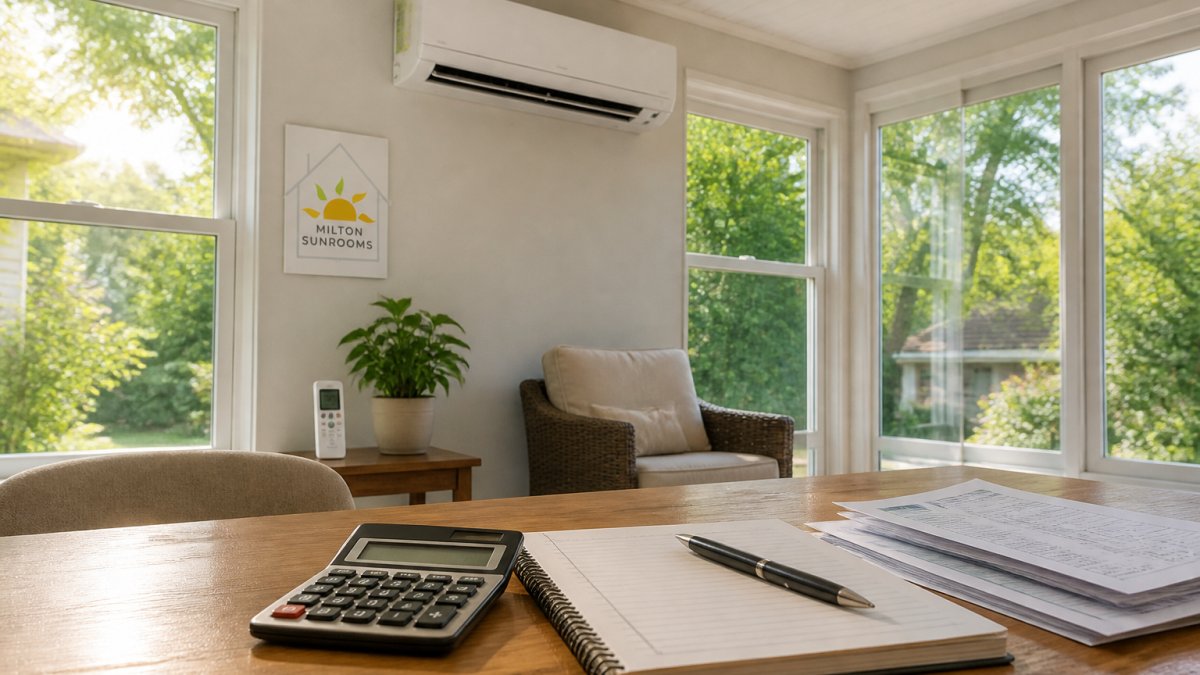
A mini-split for sunroom use is usually the best long-term answer for year-round comfort. A ductless mini-split is a small heat pump with a wall-mounted indoor air handler and an outdoor compressor. It cools in summer, heats in winter, and runs on its own thermostat, so you are not paying to condition the whole house for one room.
How a Load Calculation Actually Works
Sizing matters more than brand: too small runs constantly and never catches up; too big short-cycles, wastes energy, and leaves the room clammy. The right size comes from a cooling-load calculation, often called a Manual J calculation, that factors in:
- Room square footage and ceiling height
- Number, size, and orientation of windows
- Insulation in the roof, walls, and floor
A simplified version you can do yourself: start with 20 BTU per square foot, then add 10 to 15 percent per glass-heavy wall, 10 percent per extra foot of ceiling height, and 30 percent or more for west or south exposure. A 200-square-foot, three-wall-glass sunroom with a 10-foot ceiling and west exposure often lands near 9,000 to 12,000 BTU/h, which is why a 9,000 BTU/h unit that cools a bedroom fine can lose the battle in a sunroom.
What Drives the Installed Cost
Mini-split pricing varies widely because installed cost depends on more than the unit. The main drivers are:
- Capacity. Larger units cost more, but the jump from 9,000 to 12,000 BTU/h is usually modest compared with the jump to a multi-zone system.
- Line set length. The refrigerant lines between the indoor head and outdoor compressor have a practical limit, often around 25 feet for many single-zone units. Longer runs need more materials and labor.
- Electrical. Most mini-splits need a dedicated 15- to 20-amp, 208/230-volt circuit. If your sunroom does not have one, add the cost of an electrician running a new circuit from the panel.
Because of these variables, two sunrooms of the same size can need very different systems. Get a free quote from Milton Sunrooms and we will size the system for your actual space.
Running Costs and Efficiency
Mini-splits are typically the most efficient option for a single room because they only condition that room and because inverter-driven compressors modulate up and down instead of cycling on and off.
Actual operating cost depends on your local electric rate, how many hours the unit runs, and how well the room is shaded and insulated. The cheapest kilowatt-hour is the one you never use, which is why the low-cost steps below come first.
Zoned Control and Year-Round Use
The biggest advantage of a mini-split in a sunroom is zoned control: the room gets its own thermostat, so you can cool it in July and heat it in January without touching the rest of the house.
Humidity, Condensation, and Indoor Air Quality
Cooling a sunroom without managing humidity leaves the room feeling clammy even when the thermostat says it is cool.
Watch for these signs:
- Foggy or sweating windows in the morning
- Damp spots on window sills or frames
- A musty smell when you walk in
A mini-split or central system removes some moisture as it cools. In humid climates, a dedicated dehumidifier may be needed to hold indoor humidity in a comfortable range. Keep gutters clear and make sure water drains away from the room's base.
Your Low-Cost to High-Cost Action Plan
Work through these steps in order. Most homeowners solve the worst of the problem before spending big money.
- Close the shades during peak sun. Free. Do this today.
- Open windows for cross-ventilation. Free. Low windows on the shaded side, high windows on the sunny side.
- Add a ceiling fan. Low cost. Runs on pennies a day.
- Install an exhaust fan or roof vent. Low to moderate cost. Pulls trapped hot air out.
- Add exterior shades or awnings. Moderate cost. Stops sun before it hits the glass.
- Upgrade roof and floor insulation. Moderate cost. Cuts heat gain at the source.
- Add a window unit or portable AC. Moderate cost. Good for small rooms.
- Install a ductless mini-split. Higher cost. Best year-round comfort and zoned control.
- Extend central HVAC. Higher cost. Best when ductwork is close and the system has capacity.
A hot sunroom is a solvable problem, but the fix is rarely one product.
We design and build custom sunrooms, porches, and patio enclosures across north Fulton County and the surrounding counties, and we can work with your existing deck or porch instead of starting over.
Get a Free Quote from Milton Sunrooms and enjoy your sunroom in every season, not just the mild ones.
Frequently Asked Questions
How do you keep a sunroom cool in the summer?
Start by blocking solar heat gain with shades or reflective window film, then improve sunroom ventilation and airflow with cross-ventilation and a ceiling fan. If the room still runs hot, add a dedicated cooling source such as a mini-split or window unit. A step-by-step diagnostic before buying equipment prevents overspending on the wrong fix.
Can a mini-split cool a sunroom?
Yes. A ductless mini-split for sunroom use handles the room's cooling load without extending ductwork, and it provides zoned control so you can set a different temperature than the rest of the house. Proper sizing matters: an undersized unit runs constantly and an oversized one short-cycles, so calculate the cooling load based on square footage, ceiling height, and window area first.
Should a sunroom have its own HVAC system?
Often, yes. Extending central HVAC into a sunroom can strain your existing system if the room was not included in the original load calculation. A dedicated system such as a mini-split gives you independent temperature control and avoids overworking your main unit. A contractor can confirm whether your current system has capacity to spare.
How can you reduce heat in a sunroom without air conditioning?
Block direct sunlight with exterior shades or reflective glazing, open windows on opposite sides for cross-ventilation, run a ceiling fan to improve air circulation, and schedule heavy use for mornings and evenings. These low-cost steps reduce solar heat gain and can keep a three-season room comfortable on all but the hottest afternoons.