 how-to
Year-Round Sunroom Temperature Control Tips
Table of Contents
- Assess Your Sunroom's Current Insulation and Construction
- How to Cool a Sunroom in Summer
- How to Heat a Sunroom in Winter
- Mini-Split Systems for Sunroom Heating and Cooling
- Sunroom Insulation Tips for Year-Round Comfort
- Manage Humidity and Condensation Year-Round
- Create a Season-by-Season Temperature Control Plan
- Frequently Asked Questions
Last Updated: October 11, 2026
Assess Your Sunroom's Current Insulation and Construction
Effective sunroom temperature control begins with assessing your insulation level, window quality, and structural design. A poorly insulated sunroom will undermine any climate-control strategy.
Single-pane glass transfers heat and cold rapidly; thermal or double-pane windows with low-emissivity coatings perform better. Many three-season sunrooms lack adequate roof and wall insulation. If you see daylight around seams or feel drafts, seal these gaps before adding heating or cooling.
How to Cool a Sunroom in Summer
Summer cooling is the biggest challenge most sunroom owners face. Direct sunlight heats the space rapidly. The goal is to block solar heat gain, move air effectively, and remove excess warmth based on your sunroom's construction and insulation.
Diagnose your cooling problem first
Before buying equipment, identify why your sunroom overheats. Use a simple diagnostic process:
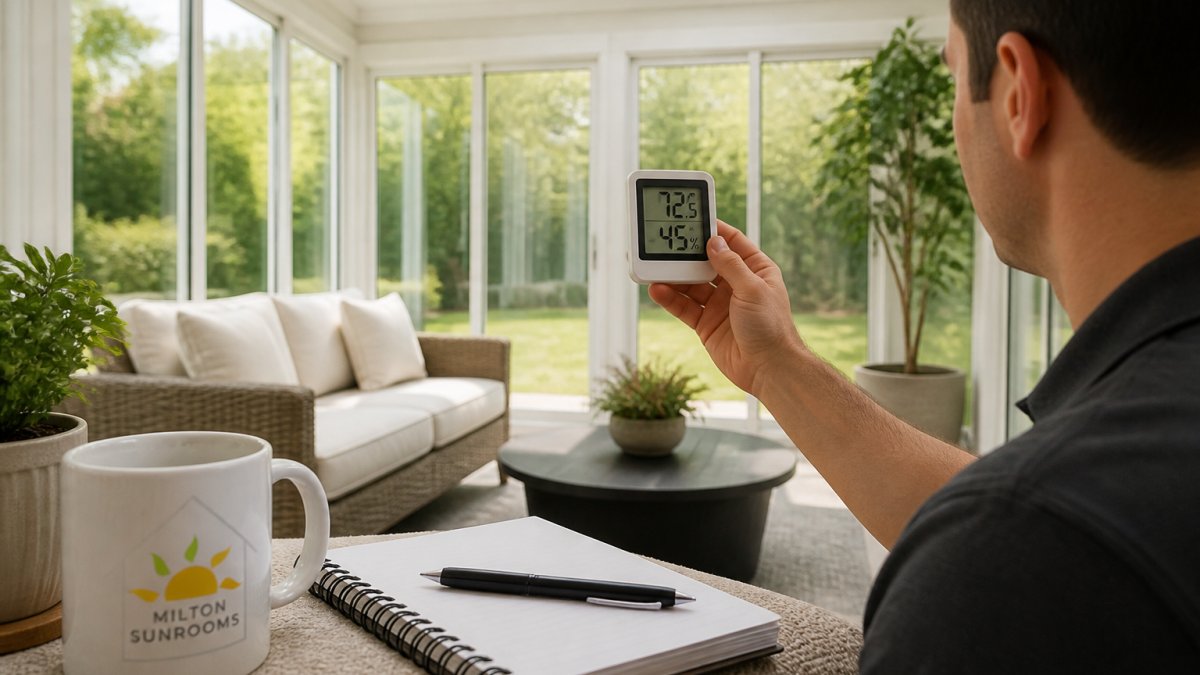
Temperature mapping: Place thermometers on all four sides and record readings at 10 AM, 2 PM, and 6 PM on a sunny day. If south and west sides are 10-15°F hotter, solar heat gain is the primary issue; if uniformly hot, poor ventilation or insulation is the culprit.
Sun exposure assessment: Note which windows receive direct sun. South and west-facing windows are the strongest summer heat sources; north-facing windows rarely cause overheating.
Airflow check: Open all windows and doors. If air feels stagnant, cross-ventilation is blocked by furniture or layout.
Insulation inspection: Touch the roof and exterior walls on a hot day. If very hot, insulation is minimal. Check for visible gaps, cracks, or daylight around seams.
This diagnostic step prevents wasted spending on cooling systems that won't solve the real problem.
Cooling strategies by sunroom type
Screen rooms and three-season rooms: These have minimal insulation and are not designed for year-round climate control. Cooling relies on ventilation and window treatments. Portable AC or mini-splits will run constantly and consume significant energy. If you need reliable cooling, upgrading to a four-season room is more cost-effective long-term.
Insulated three-season and four-season rooms: Portable AC, window units, or mini-splits are practical. A mini-split uses 30-50% less energy than a portable AC for the same output, though installation costs are higher ($3,000-$5,000 vs. $300-$1,200).
Window treatments and solar heat gain control
Window treatments are your first line of defense against summer heat. Thermal curtains, cellular shades, and reflective blinds reduce solar heat gain significantly on south and west-facing windows.
Vertical blinds are adjustable as the sun moves. Thermal shades with insulating backing trap air and prevent heat. Close them during peak sun hours (10 AM to 4 PM).
Exterior shading like retractable awnings or shade cloths is 20-30% more effective than interior treatments. A roof overhang naturally blocks high summer sun while allowing lower winter sun.
Ventilation and cross-airflow strategies
Position window openings on opposite sides to maximize cross-ventilation. Early morning and evening breezes cool the space without mechanical cooling.
Ceiling and portable fans improve comfort by creating air circulation and can make a space feel 3-5°F cooler. A ceiling fan on reverse mode pushes warm air down in winter and pulls it up in summer.
Establish a ventilation routine: open windows early morning and late evening when outdoor air is cool, close by mid-morning. This can reduce cooling energy use by 20-40% during mild days.
Portable and permanent cooling options
Portable AC units provide spot cooling. Window units ($300-$800) install in existing openings; portable units on wheels ($400-$1,200) work in any layout. Both require outside venting, which reduces efficiency slightly.
Mini-split systems deliver efficient cooling without ductwork. Installation costs $3,000-$5,000, but operating costs are 30-50% lower than portable units and maintain consistent temperature.
Connecting to your existing HVAC system requires ductwork ($1,500-$3,000) and may overload an undersized system. Have your contractor calculate the additional cooling load first.
How to Heat a Sunroom in Winter
Winter heating requires retaining warmth and adding heat efficiently. Your choice depends on insulation, usage frequency, and budget.
Heating strategies by sunroom type
Screen rooms and uninsulated three-season rooms: Space heaters are the only practical option but run constantly in cold climates, costing $100-$200 per month. Upgrading insulation or converting to a four-season room is necessary for reliable warmth.
Insulated three-season and four-season rooms: Space heaters, mini-splits, or HVAC extension work efficiently. A mini-split uses 40-60% less energy than space heaters.
Space heaters and portable heating solutions
Space heaters provide quick, affordable heat. Electric heaters warm fast and work independently; propane heaters require ventilation and safety precautions.
Portable heaters let you heat only occupied spaces, costing less than year-round heating.
Portable heaters create hot spots and don't maintain consistent temperature. They work best for occasional or supplemental heating, not all-day comfort.
Connecting to your existing HVAC system
Extending your home's heating system requires ductwork and thermostat control, costing $1,500-$3,000.
Your contractor must assess furnace capacity. An undersized furnace may cycle more frequently and reduce efficiency. In very cold climates, a furnace may not maintain comfort in an uninsulated sunroom.
Radiant floor heating circulates warm water through floor tubes, heating evenly and costing $3,000-$6,000. It works best in well-insulated rooms.
Mini-split systems for winter heating
Mini-split heat pumps extract heat from outside air and deliver it indoors. Installation costs $3,000-$5,000, but operating costs are 50-70% lower than space heaters or furnace extension.
Mini-splits maintain consistent temperature, are quieter, and provide year-round heating and cooling. They require professional installation and perform best with R-15 or higher insulation.
Maximize solar heat gain in winter
Open thermal curtains during sunny days to allow south-facing windows to warm the room naturally; close at night to trap heat. South-facing windows can contribute 10-20°F of passive heating.
Keep north-facing windows covered with thermal curtains in winter; they lose heat and rarely provide solar gain.
Maintain weatherstripping and caulk around window and door frames. Reapply caulk if cracks or gaps appear.
Mini-Split Systems for Sunroom Heating and Cooling
Mini-split systems are the most popular choice for year-round sunroom temperature control. They heat and cool independently from your home's main system.
A mini-split has an outdoor compressor and one or more indoor wall-mounted units. The indoor unit blows warm or cool air directly into the sunroom.
Efficiency is a key advantage. Mini-splits use less energy than window units or portable AC. They're quieter than most alternatives. The upfront cost is higher, but long-term operating costs are lower.
Installation requires a professional. The outdoor unit must have proper clearance, and refrigerant lines need to be run from outside to the indoor unit.
Sunroom Insulation Tips for Year-Round Comfort
Insulation is the foundation of temperature stability. Without it, heating and cooling systems work overtime and consume more energy.
Window insulation and thermal glass upgrades
Thermal glass with low-emissivity coatings reflects heat in summer and retains warmth in winter. Upgrade from single-pane to double-pane or triple-pane windows if your sunroom has older glass.
Window frames matter too. Aluminum frames conduct heat and cold. Fiberglass or vinyl frames with thermal breaks are better insulators. Weatherstripping around frames seals air leaks.
Heavy thermal curtains add an insulation layer. Close them at night in winter and during the day in summer to maximize their effect.
Roof and wall insulation considerations
Roof insulation is critical because heat rises. A poorly insulated roof lets warmth escape in winter and allows heat to penetrate in summer. Standard insulation (R-15 to R-21) is adequate for three-season rooms. Four-season sunrooms need R-30 or higher.
Wall insulation depends on your sunroom's construction. New builds can include cavity insulation. Existing additions may have limited space for insulation upgrades. Assess what's feasible for your structure.
Air sealing prevents drafts. Caulk gaps around trim, seams, and penetrations. Seal any openings where utilities enter the sunroom.
Manage Humidity and Condensation Year-Round
Humidity control is often overlooked but essential for comfort and durability. High humidity in winter causes condensation on windows and walls. Low humidity in summer makes cooling feel less effective.
Condensation forms when warm air meets cold surfaces. In sunrooms, this happens on windows and exterior walls in winter. Improve air circulation with fans to reduce condensation.
In summer, portable dehumidifiers help if your air conditioning isn't removing enough moisture. High humidity makes the space feel sticky and uncomfortable even at moderate temperatures.
Proper ventilation addresses both issues. Open windows on mild days. Use exhaust fans if your sunroom has them. Maintain airflow to prevent moisture buildup.
Create a Season-by-Season Temperature Control Plan
A flexible plan adapts your approach to seasonal conditions. This maximizes comfort while minimizing energy use.
Spring and fall transition strategies
Spring and fall are mild seasons. Use natural ventilation as much as possible. Open windows during the day when outdoor temperatures are comfortable. Close them at night if it cools down significantly.
Thermal curtains can stay open during these months. You need minimal heating or cooling. Focus on cross-ventilation and natural air movement.
Summer peak heat management
Summer requires aggressive cooling strategies. Close thermal curtains during peak sun hours. Run ceiling fans and portable fans continuously. Use portable AC or mini-splits if needed.
Open windows early morning and late evening when outdoor air is cool. Close them by mid-morning before heat builds up. This routine takes advantage of natural cooling when available.
Winter warmth retention plan
Winter demands consistent heating. Close all thermal curtains at night to trap heat. Open them during sunny days to allow solar gain through south-facing windows.
Run space heaters or your HVAC extension as needed. Keep temperatures consistent rather than letting them drop at night. Consistency is more comfortable and prevents condensation.
Maintain weatherstripping and caulk. Seal any new drafts immediately. Small gaps compound heat loss over the season.
Creating a comfortable sunroom year-round requires planning and the right combination of strategies.
At Milton Sunrooms, we build custom sunrooms designed for year-round comfort.
Frequently Asked Questions
What's the most cost-effective way to improve year-round sunroom temperature control?
Start with window treatments like thermal curtains and cellular shades, which block solar heat in summer and retain warmth in winter at minimal cost. Next, seal air leaks around frames and doors. If your budget allows, upgrading to insulated windows and adding attic or wall insulation delivers the biggest long-term impact on temperature stability and energy efficiency.
Can I use a mini-split system to heat and cool my sunroom?
Yes. A mini-split for sunroom heating and cooling is one of the most effective solutions for year-round comfort. These systems don't require ductwork, so they work well in sunrooms added to existing structures. They provide precise temperature control, run quietly, and are more energy-efficient than portable units or space heaters, though installation costs are higher upfront.
How do I stop condensation and humidity problems in my sunroom?
Condensation forms when warm, moist air meets cold surfaces. Improve ventilation by opening windows or panels when weather permits, use exhaust fans or portable dehumidifiers, and ensure your sunroom's insulation and windows minimize temperature differences between inside and outside. Proper airflow and cross-ventilation reduce moisture buildup significantly.
Will sunroom insulation tips really make a difference in temperature control?
Absolutely. Sunroom insulation tips focus on reducing heat loss in winter and heat gain in summer. Upgrading to insulated windows, adding roof and wall insulation, and sealing drafts can lower the temperature difference between your sunroom and outdoors by 10-20 degrees or more, reducing your reliance on heating and cooling systems and cutting operating costs.