 Comparison
How to Choose Energy Efficient Sunroom Glass Options
Last Updated: October 27, 2026
Quick Summary
Choose energy efficient sunroom glass by matching pane count to your climate and checking whole-unit U-factor and SHGC ratings together. Double-pane Low-E with argon suits most four-season rooms, while triple-pane Low-E fits cold climates and large glass walls. Specify frame, spacer, and air-leakage ratings too, since sunroom glass only performs as well as its whole assembly.
- Single-pane glass suits only three-season rooms and creates hot and cold spots near the glass.
- Double-pane Low-E with argon typically rates a whole-unit U-factor of 0.30 to 0.40.
- Cooling-dominated climates target a U-factor of 0.40 or lower and an SHGC of 0.25 to 0.35.
- Vary SHGC by orientation, using lower values on west walls and higher on south walls.
- Ask for the NFRC label on the exact unit going into each wall, not a generic spec sheet.
Table of Contents
- Start With Pane Count: Single, Double, or Triple Glass
- The Best Glass for a Sunroom Comes Down to Ratings
- Low-E Glass for Sunrooms: How Coatings Change Heat Transfer
- Sunroom Window U-Factor and SHGC: Reading the Labels
- Sunroom Glass Roof Options and Shading Strategies
- Frames, Spacers, and Air Leakage: Whole-Window Performance
- Lifecycle Cost, Comfort, and Condensation Risks
- Get a Free Quote for Your Sunroom Glass Plan
- Frequently Asked Questions
Start With Pane Count: Single, Double, or Triple Glass
Most homeowners shopping for energy efficient sunroom glass options start with the wrong question: which brand is best, before they know how many panes they need.
Single-pane glass is one sheet of glass with no insulating gap. Double-pane glass sandwiches a sealed air or gas space between two sheets. Triple-pane glass adds a second gap and a third sheet for the highest insulating value.
Single-Pane Glass: Where It Still Fits
Single-pane glass has one honest use: a three-season room that stays closed in winter. It costs and weighs the least, so older frames can carry it without reinforcement.
Where it fails is comfort. A single sheet has almost no resistance to heat transfer, so the pane gets cold in winter and hot in summer, you feel the chill radiating off it on a January evening and heat radiating inward on an August afternoon.
For a room you plan to use year-round, single-pane glass undercuts the entire point of the build.
Double-Pane and Triple-Pane Insulated Glass
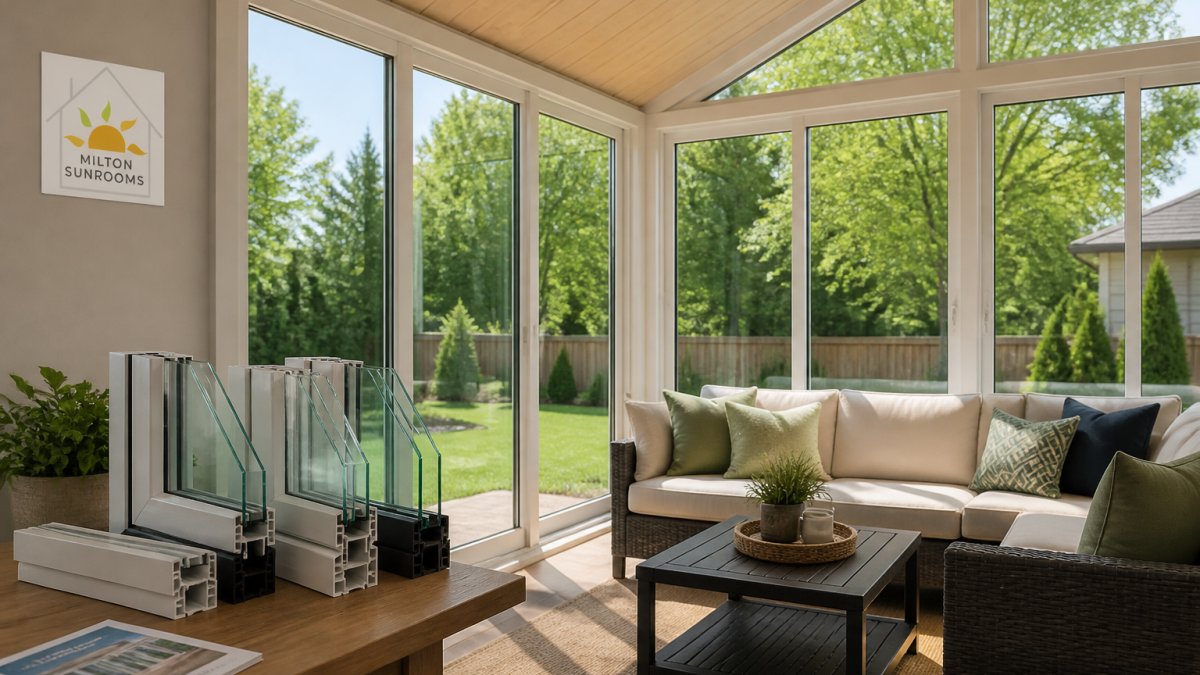
Double-pane insulated glass is the workhorse for four-season sunrooms. The sealed gap between panes slows heat transfer in both directions, and manufacturers can fill that gap with argon or krypton gas to slow it further. U.S. Department of Energy guide to window technologies explains how the sealed gap and gas fill reduce conduction.
Triple-pane glass adds a second gap and performs best in cold climates and rooms with large glass-to-floor ratios. The trade-offs are real: triple-pane units weigh more, cost more, and need frames rated to carry them.
A common mistake is assuming triple-pane is always the upgrade. In a hot climate with a well-shaded roof, the extra pane often buys less comfort than a better coating or a tighter frame.
The Best Glass for a Sunroom Comes Down to Ratings
The best glass for a sunroom is not the thickest glass, it is the assembly whose ratings match your climate and orientation.
U-factor measures how fast heat escapes through the whole window assembly. Lower is better in heating-dominated climates.
Solar heat gain coefficient (SHGC) measures how much solar heat passes through the glass. Lower blocks more heat; higher admits more free warmth in winter.
Comparing Glass Options Side by Side
Here is how the main assemblies stack up on the factors that drive comfort and energy use.
| Glass Option | Insulation (U-factor) | Solar Control (SHGC) | Best For | Main Drawback |
|---|---|---|---|---|
| Single-pane, clear | Poor | High | Three-season rooms | Cold and hot spots near glass |
| Double-pane, clear | Good | High | Mild climates, budget builds | Summer heat gain |
| Double-pane, Low-E | Good | Low to moderate | Most four-season sunrooms | Higher cost than clear |
| Triple-pane, Low-E | Best | Low | Cold climates, large glass walls | Weight and cost |
| Tinted or frosted | Varies | Low | Glare-heavy west exposures | Reduced daylight, lost views |
The pattern is clear: pane count sets insulation, and coatings set solar control. You usually need both.
Low-E Glass for Sunrooms: How Coatings Change Heat Transfer
Low-E glass for sunrooms carries a microscopic metallic coating that reflects radiant heat rather than absorbing it: in summer it pushes solar heat back outside, in winter it reflects interior warmth back into the room.
Two placement choices matter. Soft-coat Low-E on the inner surface of an insulated unit delivers strong year-round performance; hard-coat is more durable and handles humidity better, which matters in a room with plants and frequent temperature swings.
What most guides miss is that Low-E comes in different strengths. A high-solar-gain Low-E suits a room that needs winter warmth. A low-solar-gain version suits a west-facing room that overheats by 3 p.m.
Sunroom Window U-Factor and SHGC: Reading the Labels
Sunroom window U-factor and SHGC appear on the same label, and reading them together tells you how the unit will behave. A low U-factor without a matching SHGC is only half a specification. The ENERGY STAR program's climate zone guidance groups the country into zones and recommends different rating targets for each. That is the reference point to check before you sign off on a glass package.
What the Numbers Actually Mean
U-factor is the rate of heat loss through the whole window assembly, in Btu/(h·ft²·°F); lower is better. Single-pane clear typically rates around 1.0 or higher, double-pane Low-E with argon lands in the 0.30-0.40 range, and triple-pane Low-E can reach 0.20 or below.
SHGC is a ratio from 0 to 1 of how much solar heat passes through relative to incident sunlight. Clear double-pane may rate 0.60-0.70, low-solar-gain Low-E can drop to 0.25-0.35, and high-solar-gain Low-E sits around 0.45-0.55.
A Selection Matrix by Climate
Use this as a starting point, then adjust for orientation and room use. Ratings are whole-unit values; confirm them on the manufacturer's certified label.
| Climate Dominance | Priority | Target U-factor | Target SHGC | Glass Strategy |
|---|---|---|---|---|
| Cooling-dominated (hot summers, mild winters) | Solar control first | 0.40 or lower | 0.25-0.35 | Double-pane, low-solar-gain Low-E, argon fill |
| Mixed (meaningful heating and cooling) | Balance both | 0.30-0.35 | 0.35-0.45 | Double-pane, medium-solar-gain Low-E |
| Heating-dominated (cold winters) | Insulation first | 0.25-0.30 | 0.45-0.55 | Double- or triple-pane, high-solar-gain Low-E |
| Severe cold, large glass walls | Insulation and condensation control | 0.20-0.25 | 0.40-0.50 | Triple-pane, warm-edge spacers, high-solar-gain Low-E |
How Orientation Changes the Target
Climate sets the baseline, but orientation fine-tunes it. A west-facing wall takes peak afternoon sun and benefits from a lower SHGC than a north-facing wall in the same climate.
A common pattern is to specify one glass package for the whole room and then regret the west wall. Better practice is to vary SHGC by orientation within the same project, lower on the west, higher on the south, while keeping U-factor consistent.
Reading the Label Like a Pro
Three checks catch most mistakes:
- Confirm the rating is a whole-unit value, not center-of-glass. The label should state the whole-unit U-factor and SHGC.
- Check that the SHGC matches your climate priority, not just the U-factor. A great U-factor with the wrong SHGC still overheats in summer.
- Verify the unit is certified by the National Fenestration Rating Council (NFRC) and, where applicable, carries the ENERGY STAR label for your zone.
For homeowners working through the summer side of this trade-off, our guide to sunroom climate control for hot summers walks through shading, ventilation, and glass choices together.
Sunroom Glass Roof Options and Shading Strategies
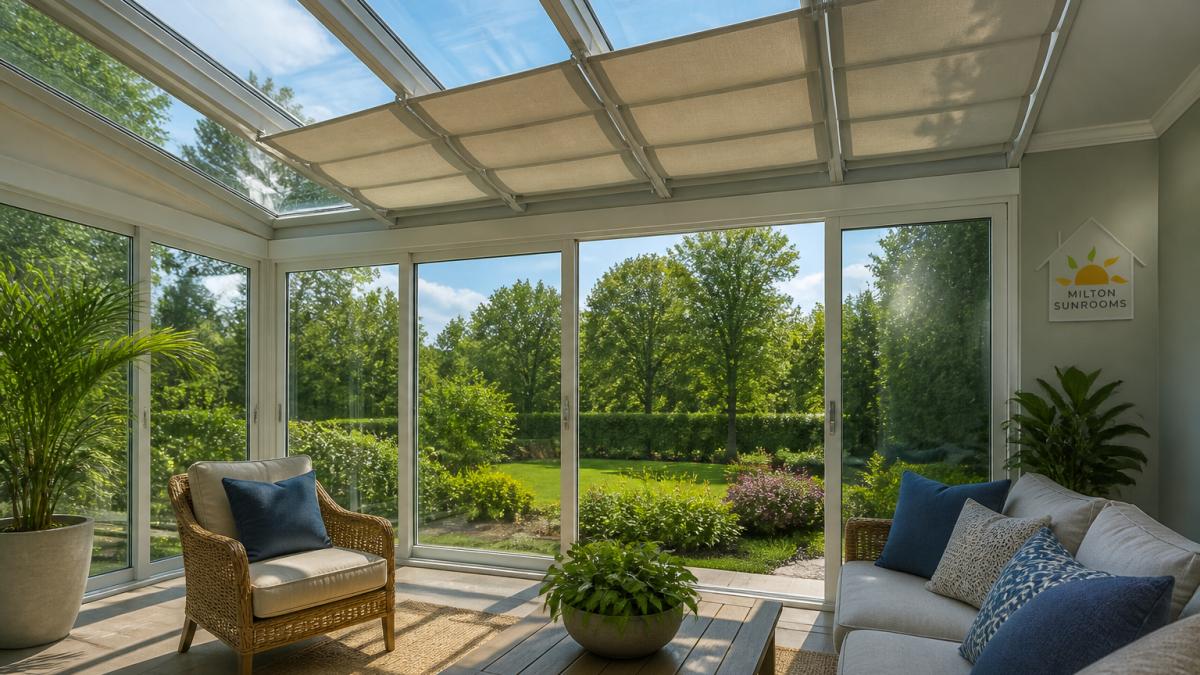
A glass roof delivers the most natural light and widest sky view of any sunroom option, but it also takes the heaviest solar load, because a horizontal surface faces the sun directly at midday.
Performance glass with a low SHGC is the starting point for a glass roof; shading does the rest.
A solid roof trades sky view for predictable thermal performance and pairs well with large wall glazing. If heavy rain is a concern alongside sun, our comparison of which sunroom roof handles heavy rain best covers how each roof style sheds water.
Frames, Spacers, and Air Leakage: Whole-Window Performance
Whole-window performance is the rating that counts, and glass is only part of it. Frames, spacers, and air sealing decide whether the glass you paid for actually performs, a high-performance unit in a conductive frame with a poor edge seal can underperform a modest unit in a well-engineered assembly.
Frame Conductivity and Thermal Breaks
Vinyl frames insulate well and resist moisture, which is why they are common in sunrooms.
The frame's conductivity shows up as edge-of-glass effects: the perimeter of the glass runs colder in winter and hotter in summer than the center. That is why whole-unit U-factor is always worse than center-of-glass U-factor, and why a warm-edge spacer matters.
Spacers: The Edge Weak Point
The spacer separates the panes at the perimeter and seals the gas fill. Older aluminum box spacers conduct heat and create a cold edge where condensation forms first. Warm-edge spacers, silicone foam, butyl, or a hybrid design, reduce that conduction and keep the edge closer to room temperature, which means less condensation on cold mornings and a slightly better whole-unit U-factor.
Air Leakage: The Quiet Killer
Air leakage is rated separately from U-factor and SHGC and is often overlooked. A perfectly rated glass unit in a poorly sealed frame leaks conditioned air at every joint, gaps at the frame-to-wall connection, operable windows and doors, and the sill show up as drafts and higher bills long after the glass was chosen.
When comparing products, ask for the air-leakage rating, typically expressed in cubic feet per minute per square foot of frame area at a specified pressure difference. Lower is better. A tight assembly protects the investment you made in the glass.
Seals, Gas Fill, and Longevity
The seal that holds the gas fill and keeps moisture out determines how long the unit performs. A failed seal shows up as fogging between panes, and the unit then needs replacement. Desiccant in the spacer absorbs residual moisture, and a well-made dual-seal system resists failure longer, in a sunroom with wide temperature swings, seal quality is the difference between a unit that lasts and one that fogs within a decade.
Putting It Together
A whole-window specification worth signing off on names the glass package, frame material and thermal break, spacer type, gas fill, and air-leakage rating. If any is missing, the assembly is underspecified, for year-round use, the frame and seal are what make the glass perform.
Lifecycle Cost, Comfort, and Condensation Risks
Lifecycle cost is where cheap glass stops looking cheap. A lower upfront price for clear double-pane often returns as higher cooling bills, added shade purchases, and a room nobody uses in August.
Condensation is the tell: moisture inside the panes points to high indoor humidity or a cold glass surface, while moisture between panes means the seal has failed and the unit needs replacement.
Comfort is the payoff that does not show on a utility bill: a room you can use in February and July adds living space you actually occupy. To put the ratings to work day to day, our year-round temperature control tips cover the habits that keep a sunroom comfortable across seasons.
Get a Free Quote for Your Sunroom Glass Plan
Milton Sunrooms designs and builds custom sunrooms, porches, and patio enclosures, and we can repurpose an existing deck or porch. Contact Milton Sunrooms to schedule a free consultation and quote for your project. Every project is built to your specifications with quality materials, backed by our 100% customer satisfaction guarantee.
When you are ready to compare energy-efficient window options for your build, see our four-season sunroom construction service.
Frequently Asked Questions
What type of glass is used for sunrooms?
The right sunroom glass depends on whether you want a year-round room or a seasonal one, and on how much sun the room receives.
Does Low-E glass help keep a sunroom cooler?
Ask for the SHGC number, not just the Low-E label.
Is double-pane glass worth it for a sunroom?
Compare U-factor and SHGC ratings across options rather than assuming more panes is always better.
How do you choose glass for a sunroom roof?
Ask your contractor to model roof exposure before committing to an all-glass design.
The right glass package turns a sunroom from a seasonal extra into a room your family uses every month of the year. Milton Sunrooms brings custom design, quality materials, and a satisfaction guarantee to every build, and we will walk you through pane count, coatings, and ratings before a single panel is ordered. Get started with Milton Sunrooms and build a sunroom you can enjoy in every season.